

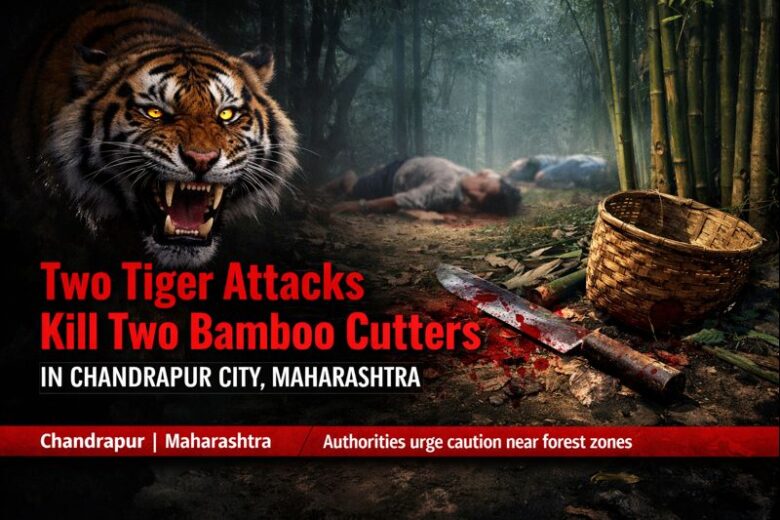
Chandrapur district in Maharashtra has been deeply disturbed by a tragic wildlife incident. Two bamboo cutters lost their lives in twin tiger attacks, spreading fear among local residents and forest workers. The incident has once again highlighted the serious issue of human–wildlife conflict in Maharashtra, especially in areas close to tiger habitats.
Details of the Tiger Attack in Chandrapur
According to Chandrapur tiger attack news, two bamboo cutters were killed after entering nearby forest areas to collect bamboo, which was their main source of daily income. While working in the forest, they were suddenly attacked by tigers. These twin incidents clearly show how dangerous forest-based jobs have become in the Chandrapur region.
The Chandrapur city tiger attack has emerged as one of the major tiger attack cases reported in Maharashtra in recent times. The tragedy is now part of the latest tiger attack news from Chandrapur, and forest officials are investigating the exact reasons behind the attacks.
The tiger attack took place around 45 minutes past noon on Saturday in the buffer zone of the Tadoba–Andhari Tiger Reserve.
Bamboo Cutters Killed by Tiger: A Repeated Problem
This incident is not an isolated case. In the past, several bamboo cutters killed by tiger incidents have been reported near forest boundaries. Once again, bamboo cutters killed in a tiger attack at Chandrapur have exposed the unsafe conditions faced by people who depend on forests for their livelihood.
Every forest worker killed by a tiger leaves behind a grieving family and creates panic in nearby villages, where forest work is often the only source of income.
Also Read: Anti-Poaching Camp Staff Killed in Tiger Attack at Bandipur Reserve
Human–Wildlife Conflict in Maharashtra
These incidents clearly reflect the growing human–wildlife conflict Maharashtra is facing. Expanding villages, daily forest dependence, and shrinking buffer zones are increasing encounters between humans and wild animals.
The recent Maharashtra tiger attack news has sparked discussions about:
Improving safety for workers in forest and buffer zones
Providing better compensation and awareness programs for affected families
Strengthening forest patrols and early warning systems
1 Comment