

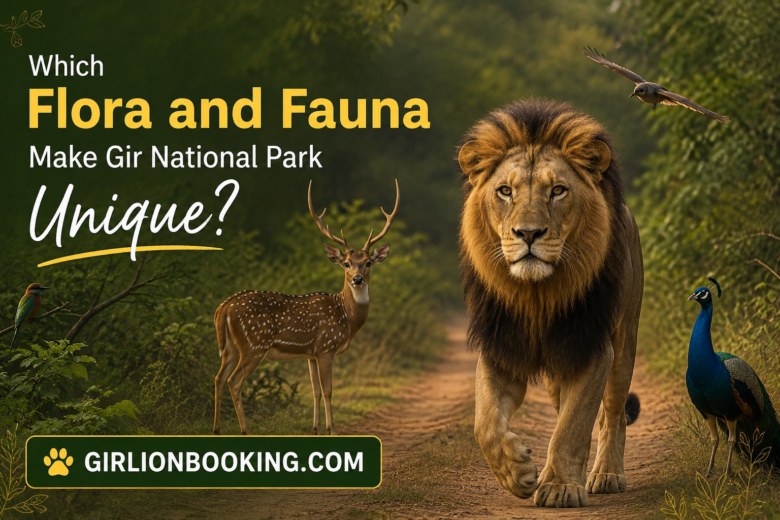
If you have ever dreamed of seeing a wild lion, stroll through golden grassland beneath an open sky, Gir National Park in Gujarat is the place on earth where that dream actually comes true. There really isn’t any other forest in Asia that can offer that same experience. The Asiatic lion is located only here, and that fact by itself puts Gir way beyond every other wildlife destination in the country.
But the story of Gir is much bigger than just one animal. From towering teak trees to tiny spotted deer, from marsh crocodiles to over 300 species of birds, the flora and fauna of Gir National Park together create one of the most complete and living ecosystems you will ever step into.
The Forest That Holds Everything Together: Gir Flora
You cannot truly understand Gir’s wildlife without first understanding its forests. The vegetation here is what makes survival possible for every creature living inside.
Gir is classified as a dry deciduous forest, and it is actually the largest of its kind in Western India. About half of the entire forest is covered by teak trees, which is why it is often called the “Very Dry Teak Forest.” These tall, hardy trees form a canopy that keeps the ground cool and provides shelter to dozens of species through every season.
Beyond teak , the forest has this really rich mix of trees , like jamun, amla, babul, banyan, tendu, dhak, and the beautiful “Flame of the Forest” too. Along the banks of rivers such as Hiran, Shetrunji, and Datardi, you can spot dense patches of banyan, peepal, tamarind, and karanj , kind of tucked in there quietly. These river-side trees really matter because they bring in birds, and they also give animals proper drinking places all year round.
In the drier zones, thorny scrub jungles and open grasslands take over. Plants like babul, ber, and various species of spear grass and elephant grass grow here. These grasslands are not empty patches. They are the hunting grounds of lions, the grazing fields of deer, and the nesting zones of ground birds.
The park is home to over 400 recorded plant species. This variety of vegetation is what supports every single animal that lives inside Gir National Park.
The Star of Gir: The Asiatic Lion
There is simply no way to talk about Gir National Park wildlife without starting here. The Asiatic lion is the reason this park was created and the reason it still exists in the form it does today.
By the early 1900s, these lions had been hunted almost to the point of extinction, just a few left in the Gir forest. You know, only a small set remained there. Then thanks to many years of protection and conservation , the situation changed in a big way. The 2025 census noted around 891 Asiatic lions in Gujarat, a quite impressive lift from 674 in the earlier count, just five years before.
The Asiatic lion is different from its African cousin in a few visible ways. It is slightly smaller in size, carries more prominent belly folds, and has bushier elbow tufts. When you see one during a Gir jungle safari, you will notice the sheer calm it carries. These are animals completely at home in their territory.
Gir is the only place outside Africa where any subspecies of wild lion survives. That makes every sighting here genuinely rare in the context of the entire planet.
Other Mammals You Will Encounter in Gir
Beyond the lion, the Gir forest is full of life. It shelters around 38 mammal species, and many of them are spotted frequently during a jeep safari.
The Indian leopard lives alongside lions in the same territory, though sightings are rarer since leopards are more secretive. Striped hyenas, golden jackals, and sloth bears are also present in good numbers, mostly in the denser areas of the forest.
Herbivores are everywhere. Chital, also called spotted deer, are the most commonly seen animals in Gir. They move in herds and are often spotted in clearings near water. Sambar deer, nilgai (blue bull), wild boar, chinkara (Indian gazelle), and four-horned antelope are all part of the grassland community here.
Smaller mammals like Indian mongoose, Indian palm civets, jungle cats, desert cats, porcupines, hares, and the extremely rare rusty-spotted cat also inhabit the park. Seeing any of these during a safari is a good day in the jungle.
Birds of Gir: A Paradise for Birdwatchers
Gir National Park is not just about big cats. It is one of the best birdwatching destinations in Gujarat. The park records over 300 bird species, including both resident and migratory ones.
You notice a few birds that kinda grab your attention, like the Brown Fish Owl , Indian Pitta , Indian Woodpecker, Crested Tree Swift, and then the Griffon Vulture , also the Hawk Eagle. Near the rivers and waterbodies, there are painted storks, kingfishers, herons , and the whole place feels sort of alive. The Kamleshwar Dam inside the park is a popular hangout for waterbirds, and yes, you might even get crocodile sightings around there too.
The Gir Somnath district around the park holds a surprisingly large number of exotic birds, and serious birdwatchers often extend their stay specifically to explore this area.
Reptiles and the Marsh Crocodile
Gir shelters around 37 reptile species. The one that stands out is the mugger or marsh crocodile. Gir has the highest number of mugger crocodiles of any location in India. A special enclosure within the forest is dedicated to crocodile conservation, and spotting one basking near the Kamleshwar reservoir is very common.
Snakes like the Indian cobra, python, and several non-venomous species also live throughout the park. Reptile enthusiasts will find Gir genuinely rewarding.
Why Gir’s Biodiversity Cannot Be Found Anywhere Else
What makes Gir National Park unique is not one single animal or one single tree. It is the combination. The dry teak forests, the riverside evergreen patches, the open grasslands, and the scrub jungles all exist together within 1,412 square kilometres. This variety of habitats is what allows such a wide range of animals to live here.
Gir has about 2,375 faunal species overall, spanning mammals , birds, reptiles, and more than 2,000 types of insects. Somehow the whole environment keeps going because every bit supports the next. The trees provide nourishment to the deer, the deer then sustain the lions. The rivers, in turn, back the crocodiles and also the birds. If you take away even one part, the entire balance starts to shift.
Conservation efforts, strict safari regulations, and community involvement have all played a role in keeping this balance intact. Today, Gir stands as one of India’s greatest wildlife conservation success stories.
Plan Your Visit Gir National Park
The best time to visit Gir National Park is between October and March, when the weather is comfortable and animal sightings are more frequent. The park stays closed from mid-June to mid-October due to the monsoon.
You can book your Gir lion safari online. Options include the Gir Jeep Safari, the Devalia Safari Park (also called the Interpretation Zone, ideal for guaranteed sightings), and the Kankai Temple Safari. Safari slots last around three hours and must be booked in advance since offline booking is not available.
FAQs
A: It is the only natural habitat of the Asiatic lion outside Africa.
A: As of the 2025 census, around 891 Asiatic lions live in Gujarat’s Gir region.
A: Teak, jamun, babul, banyan, amla, tendu, and Flame of the Forest are among the most common.
A: Brown Fish Owl, Indian Pitta, Indian Woodpecker, Griffon Vulture, and painted storks are frequently seen.
A: Yes. Gir has the largest population of marsh crocodiles in India.
A: Yes, though sightings are rarer than lion sightings since leopards are more secretive.
A: October to March offers the best weather and highest chances of animal sightings.
A: It is the Gir Interpretation Zone, located 13 km from Sasan Gir, offering shorter safaris with guaranteed wildlife sightings.
A: No. Night safaris are not permitted inside Gir National Park.
Conclusion
Gir National Park is not only some spot where lions are living. It feels like a living breathing system where the forest, the water, and nearly every creature inside, are tied together you could say. The blend of dry teak woodland, the river edges, open grass areas, and scrub land forms habitat for everything really, from the grand Asiatic lion down to a small rusty spotted cat, from a marsh crocodile just sunning itself to a Brown Fish Owl quietly observing from a branch.
No other forest in India, and indeed no other forest in the world, gives you the Gir experience. If you are planning a wildlife trip to Gujarat, the flora and fauna of Gir National Park deserve to be at the top of your list.