

Gujarat’s Gir National Park is one of India’s most iconic wildlife sanctuaries and the only natural home of the Asiatic lion (Panthera leo persica). Beyond its stunning dry forests and open grasslands, Gir tells a story of survival, conservation, and human intervention that saved one of the world’s rarest big cats from extinction.
This blog explores the Asiatic lion’s history in Gir National Park, detailing population milestones, conservation achievements, ecotourism initiatives, and cultural significance—all updated up to 2026. Whether you’re planning a wildlife safari, interested in nature photography, or curious about lion conservation, this guide covers everything.
Introduction: The Pride of Gujarat – Gir National Park
Located in the Saurashtra region of Gujarat, Gir National Park spans over 1,412 km², including protected forest, wildlife sanctuary areas, and ecotourism zones. It is home not only to the Asiatic lion but also to leopards, hyenas, jackals, antelopes, and hundreds of bird species.
Gir’s historical and ecological importance is matched by its cultural significance. Lions have long been revered in local folklore, symbolising strength, courage, and pride, and are central to the identity of Gujarat’s wildlife heritage.
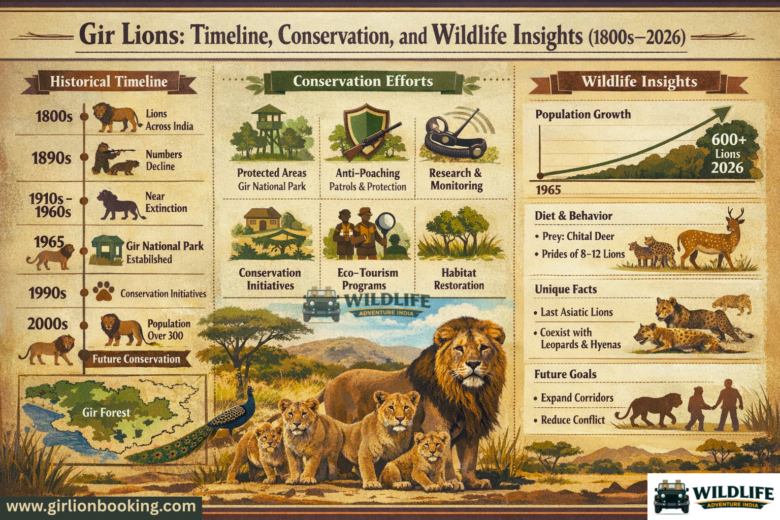
Asiatic Lion History in Gir National Park: A Comprehensive Timeline (Expanded)
The Asiatic lion’s journey in Gir National Park is a remarkable story of survival, conservation, and resurgence—from near-extinction to a thriving population in the wild. This timeline now includes historical events, scientific milestones, ecological notes, and socio-cultural details.
Pre-1800s: Widespread Range and Cultural Significance
- Asiatic lions roamed across India, the Middle East, and parts of Europe, including Persia, Turkey, and Greece.
- Habitats included grasslands, scrublands, dry forests, semi-arid plains, and riverine areas, demonstrating adaptability.
- Lions were symbols of royalty, power, courage, and protection in folklore and religious traditions across regions.
- Hunting was conducted for sport, trophies, and ceremonial purposes, contributing to population decline.
- Populations gradually retreated to forested areas, especially in Gujarat, as human settlements expanded.
- Early records by travellers and naturalists described dense prides and the territorial dominance of Asiatic lions.
1800s: Declining Numbers and Habitat Fragmentation
- Rapid deforestation, expansion of agriculture, and new settlements reduced available habitats.
- Hunting intensified under colonial officers and princely rulers, targeting lions for sport.
- Local communities observed lions near villages, leading to human-lion conflicts.
- By the late 19th century, Asiatic lions were largely confined to Gir forests in Saurashtra, the last stronghold.
- Historical reports documented fewer than 200 lions in the wild, signalling a severe population crisis.
1913: Protected Hunting Reserve – First Conservation Attempt
- The Nawab of Junagadh declared Gir Forest a protected hunting reserve, restricting hunting except under royal permits.
- Villagers were asked to report lion sightings to reduce accidental killings.
- This marked the first organised effort to conserve Asiatic lions in India.
- Forest officials started monitoring lion numbers and creating rudimentary protection zones.
- Despite restrictions, limited hunting continued, posing challenges to early conservation.
Early 1900s: Near Extinction
- The population dropped to fewer than 50 lions, making them critically endangered.
- Habitat fragmentation, poaching, and livestock predation conflicts threatened survival.
- Wildlife researchers and forest officers began scientific studies to understand lion ecology.
- Calls for formal protection and habitat preservation grew louder.
1965: Establishment of Gir National Park & Wildlife Sanctuary
- Officially designated Gir National Park & Wildlife Sanctuary to conserve the Asiatic lions.
- Hunting was completely banned, and the park was divided into core and buffer zones.
- Initial population estimates: ~40–50 lions.
- Legal protection reduced human disturbance and grazing in critical habitats.
- Scientific monitoring programmes were initiated to track population recovery.
- Policies emphasised ecological balance, ensuring prey populations (deer, antelope, and wild boars) thrived.
1970s–1980s: Early Conservation Programmes
- Anti-poaching patrols and forest ranger programmes were strengthened.
- Artificial waterholes, ponds, and grassland restoration were implemented to support prey species.
- Lion behaviour studies began, documenting pride structure, hunting patterns, and reproductive health.
- Local communities were included in awareness programmes to prevent retaliation killings.
- Early conservation success showed a gradual increase in population, laying the foundation for ecotourism.
1990s: Population Recovery & Eco-Tourism Initiatives
- Lion population estimates reached 200–300 individuals.
- Eco-tourism zones such as Devalia and Sasan Gir core zones were developed to fund conservation.
- Guided Gir jungle safaris educated visitors while providing a livelihood to locals.
- Core and buffer zones were refined, improving habitat management and connectivity.
- Prey species monitoring ensured a stable food base for growing lion populations.
- National and international awareness campaigns highlighted Asiatic lion conservation.
2000s: Global Recognition
- The population crossed 300 lions, marking the first major recovery milestone.
- Scientific monitoring, including GPS collars, camera traps, and veterinary care, became routine.
- Gir National Park became a model for global big cat conservation, inspiring programmes in Africa and Asia.
- The government launched human-lion coexistence initiatives, compensating livestock losses and reducing conflict.
- Research focused on genetic diversity, ensuring the long-term survival of lions.
2010s: Expansion and Genetic Management
- Lion numbers exceeded 500 individuals, reflecting successful anti-poaching and habitat strategies.
- Forest corridors were expanded to connect fragmented habitats, supporting territorial dispersal.
- Devalia and Ambardi Safari Parks became prominent ecotourism hubs.
- Community-based programmes trained locals as eco-guides, wildlife trackers, and forest stewards.
- Conservationists monitored genetic diversity to prevent inbreeding within isolated populations.
- Advanced research documented social behaviour, pride dynamics, and inter-lion conflicts in Gir.
2020s: Consolidation and Global Conservation Icon
- The population surpassed 600 lions, solidifying Gir as a global conservation success story.
- Collaboration with NGOs, research institutions, and local authorities ensured sustainable forest management.
- Gir remained the only natural habitat of Asiatic lions in the world, emphasising continued protection.
- Advanced technology like drones, GIS mapping, and genetic analysis improved monitoring.
- Ecotourism continued to provide funding for habitat protection, community programmes, and research.
- Forest restoration projects supported prey populations and ecological balance.
2026: Current Status and Outlook
- Estimated population: 650+ Asiatic lions.
- Genetic monitoring, ecotourism initiatives, and habitat protection continue to thrive.
- Gir serves as a global model for wildlife conservation, balancing ecological needs with tourism.
- Community involvement ensures coexistence, education, and livelihood opportunities.
- Ongoing research includes climate impact studies, disease monitoring, and wildlife corridor expansion.
Additional Context and Insights
- Lion Subpopulations: Lions in Gir are now organised into distinct territorial prides, supporting genetic diversity.
- Prey Management: Regular monitoring of sambar deer, spotted deer, nilgai, and wild boar ensures a stable food chain.
- Human-Lion Conflict Mitigation: Livestock compensation, awareness campaigns, and fencing reduce conflicts.
- Tourism Education: Safari zones include interpretive centres, visitor education programmes, and wildlife photography opportunities.
- Cultural Heritage: Lions remain a symbol of courage, power, and protection in local folklore and Gujarat’s cultural identity.
- Scientific Milestones: Studies include population ecology, predator-prey dynamics, and disease surveillance.
- Habitat Restoration: Waterhole creation, grassland rejuvenation, and afforestation continue to improve ecosystem health.
- Climate Resilience: Measures are being taken to protect lions from droughts and seasonal water scarcity.
Population Growth of Asiatic Lions in Gir
| Period | Population Estimate |
| Early 1900s | <50 lions |
| 1965 | ~40–50 lions |
| 1990s | ~200–300 lions |
| 2000s | >300 lions |
| 2010s | ~500–550 lions |
| 2020s | >600 lions |
| 2026 | Estimated 650+ lions |
Key Conservation Efforts in Gir National Park
1. Anti-Poaching Measures
- Forest guards patrol the Gir forest and core zones.
- Poaching incidents have drastically reduced due to strict laws and community vigilance.
2. Habitat Restoration
- Afforestation programmes and waterhole creation improved lion habitats.
- Restoration ensured the availability of prey species like deer, antelopes, and wild boars.
3. Community Involvement
- Villagers are incentivised to protect lions and forests.
- Eco-tourism programmes provide alternative livelihoods.
4. Scientific Monitoring
- GPS collars track lion movements and health.
- Regular veterinary care maintains population health and genetic diversity.
5. Eco-Tourism Initiatives
- Devalia and Ambardi Safari Parks allow safe wildlife viewing.
- Gir jungle safaris provide education while supporting conservation funds.
Cultural Significance of Lions in Gir
- Lions symbolise strength, courage, and pride in Gujarat folklore.
- Many local legends associate lions with the spiritual guardianship of villages.
- Lions play a central role in Gujarat’s identity and wildlife tourism.
- Visitors experience both ecological and cultural significance during safaris.
Best Practices for Wildlife Tourism in Gir
- Visit during winter (October–March) for optimal sightings.
- Book jungle safari permits in advance.
- Use neutral clothing to blend with the forest.
- Maintain silence, respect wildlife, and never feed animals.
- Carry binoculars and cameras for wildlife photography.
Gir National Park: Key Attractions for Visitors
- Gir Jungle Safari – Core zone for lions and predators.
- Devalia Safari Park – Controlled zone for guaranteed wildlife viewing.
- Ambardi Safari Park – Less crowded, ideal for ecotourism.
- Kamleshwar Dam – Perfect for birdwatching and spotting crocodiles.
- Crocodile Point – Learn about mugger crocodile conservation.
- Kankai Mata Temple – Cultural landmark within Gir Forest.
Conclusion
From fewer than 50 lions in the early 1900s to over 650 today, Gir National Park Asiatic lions are a remarkable conservation success story. With strict habitat protection, anti-poaching measures, ecotourism initiatives, and community involvement, Gir has become the world’s only natural home for Asiatic lions.
Visitors can explore Gir Forest, witness the majestic Asiatic lion, participate in ecotourism, and understand the deep cultural significance of lions in Gujarat. For wildlife enthusiasts, photographers, and nature lovers, Gir offers a truly once-in-a-lifetime experience.