

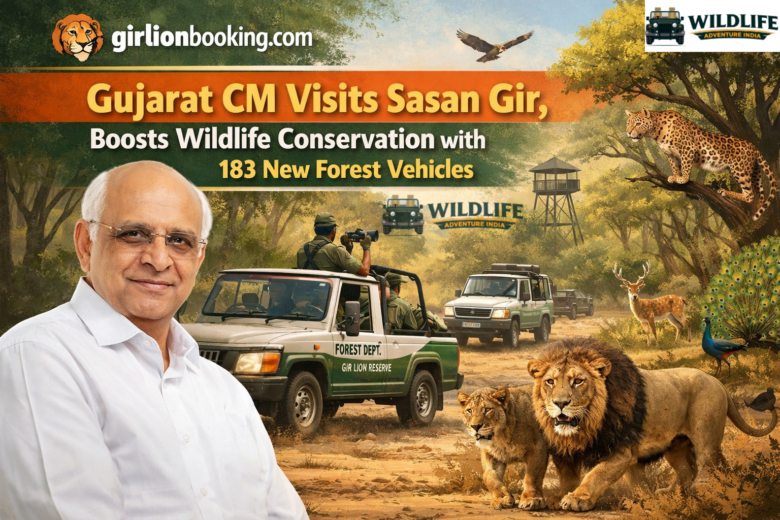
Sasan Gir, the last natural habitat of the majestic Asiatic lion, witnessed a high-profile and symbolic visit on Thursday as Gujarat Chief Minister Bhupendra Patel embarked on an early-morning jungle safari in the renowned Gir forest. The visit underlined the Gujarat government’s unwavering commitment to wildlife conservation, with a special focus on strengthening protection measures for the iconic Asiatic lion and preserving the rich biodiversity of the region.
The Chief Minister’s safari through the dense forest landscape provided a firsthand experience of the thriving ecosystem within Gir. During the excursion, he observed several Asiatic lions roaming freely in their natural surroundings and encountered them at two different locations within the Keramba Thana forest range. The sight of healthy lions moving confidently across their habitat reflected the success of decades-long conservation initiatives undertaken by the state.
Apart from lions, Chief Minister Patel also spotted various other wildlife species, including herbivores and birdlife that form an integral part of the forest’s ecological balance. Expressing satisfaction over the overall condition of the forest, he noted that Gir continues to stand as a shining example of how scientific wildlife management, community involvement, and strong administrative support can together ensure the survival of endangered species.
The visit served as an opportunity for the Chief Minister to review ongoing conservation efforts and assess the effectiveness of protection strategies implemented by the Forest Department. Officials briefed him on the multi-layered conservation framework adopted in Gir, which includes habitat development, continuous monitoring, use of modern technology, rapid-response rescue systems, and active participation of local communities living in and around the forest areas.
According to the 2025 Asiatic lion population census, Gir and the broader Saurashtra lion landscape are now home to an estimated 891 lions. This remarkable figure reflects a steady and sustained increase in lion numbers over the years, attributed to meticulous planning, scientific management practices, and the dedication of frontline forest personnel. The census findings reaffirm Gujarat’s global leadership in large carnivore conservation and highlight Gir’s role as a secure and flourishing habitat for the species.
During his interactions with forest officials, Chief Minister Patel praised the tireless efforts of forest staff, guards, and officers who work around the clock to protect lions and other wildlife. He acknowledged the challenges involved in managing a growing lion population, particularly as lions expand beyond the core Gir area into adjoining forest regions, coastal belts, and human-dominated landscapes. The Chief Minister emphasized the importance of continued vigilance, improved infrastructure, and enhanced coordination to ensure harmonious coexistence between humans and wildlife.
Gir Safari Park, one of the most popular wildlife tourism destinations in the country, currently operates 13 designated safari routes across Gir and its adjoining forest areas. These routes offer visitors a regulated and eco-friendly way to experience the forest while minimizing disturbance to wildlife. Officials informed the Chief Minister that tourist footfall has witnessed a noticeable rise in recent weeks, especially following Prime Minister Narendra Modi’s visit to Gir on March 3, which coincided with World Wildlife Day celebrations.
The increased visibility and national attention generated by high-level visits have further boosted interest in Gir as a wildlife destination. This surge in tourism has had positive ripple effects on the local economy, creating additional livelihood opportunities for communities involved in eco-tourism, guiding services, hospitality, transport, and forest-related activities. The state government has consistently emphasized that conservation and community welfare must go hand in hand, ensuring that residents become stakeholders in protecting the forest and its wildlife.
During the visit, Deputy Conservator of Forests (DCF), Sasan Gir, Prashant Tomar, provided a detailed briefing to the Chief Minister on various conservation initiatives currently underway. These include measures for lion health monitoring, disease surveillance, rescue and rehabilitation of injured or distressed animals, and awareness programmes aimed at reducing human-wildlife conflict. Senior forest officials accompanied the Chief Minister throughout the safari and subsequent review meetings, offering updates on patrolling mechanisms, use of technology such as GPS tracking and camera traps, and emergency response systems.
A major highlight of the day was the flagging off ceremony of 183 newly inducted vehicles for forest personnel at Sasan Gir. This significant addition to the Forest Department’s fleet marks a substantial boost to Gujarat’s wildlife protection infrastructure. The newly inducted vehicles have been procured under various Forest Department schemes with the objective of improving mobility, response time, and operational efficiency of frontline staff.
The fleet includes 174 field bikes designed for patrolling rugged terrain and forest tracks, six Bolero Camper vehicles for field operations and staff movement, and three specially modified wildlife rescue vehicles equipped to handle emergencies involving injured or stranded animals. These vehicles will be deployed across Gir, Greater Gir, the wider lion landscape, and other forest regions of Gujarat, strengthening the state’s capacity for surveillance, protection, rescue, and rehabilitation operations.
Addressing officials at the flag-off event, Chief Minister Patel highlighted the critical role played by forest personnel in safeguarding Gujarat’s natural heritage. He stated that providing modern equipment and logistical support is essential to empower frontline staff and ensure their safety while performing challenging duties in remote and often risky environments. The induction of new vehicles, he noted, would enable quicker response to emergencies, more effective patrolling, and better coordination during rescue operations.
Before the vehicle flag-off ceremony, the Chief Minister also visited the Forest Department’s rescue centre at Sasan Gir to review facilities and preparedness. He inspected infrastructure related to animal care, treatment, and rehabilitation, and discussed protocols for handling wildlife emergencies. Officials briefed him on the centre’s role in responding to incidents involving injured lions, leopards, and other wildlife, as well as its contribution to reducing human-wildlife conflict in surrounding areas.
Several senior officials were present during the visit, including Principal Secretary (Forest and Environment) Dr Vinod Rao, Principal Chief Conservator of Forests Dr Jaipal Singh, and other top officers of the Forest Department. They reiterated the department’s commitment to adopting innovative approaches and strengthening collaboration with scientific institutions, conservation organizations, and local communities.
Officials emphasized that the induction of the new vehicle fleet would significantly enhance the efficiency, reach, and effectiveness of forest operations across the state. Improved mobility will allow forest staff to cover larger areas, conduct regular monitoring, respond swiftly to distress calls, and ensure better protection of wildlife habitats.
The Chief Minister’s visit to Sasan Gir not only reaffirmed the government’s focus on conservation but also sent a strong message about the importance of sustained investment in forest infrastructure and human resources. As Gujarat continues to balance conservation, tourism, and community development, Gir stands as a powerful example of how dedicated efforts can secure the future of endangered species while promoting inclusive growth.