

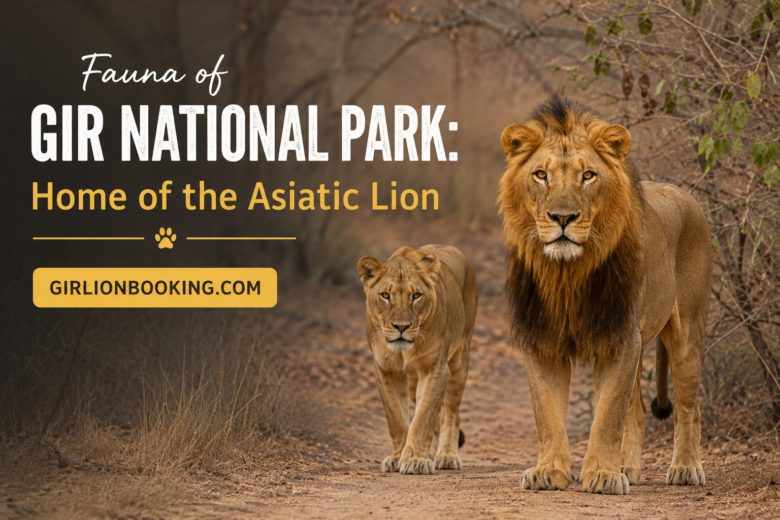
Deep inside the forests of Gujarat, India, lives a creature that has survived against all odds. The Asiatic lion, once almost gone from this earth, now roars proudly in Gir National Park. This place, also known as Sasan Gir, is the only natural habitat of the Asiatic lion outside Africa. If you dream of seeing a wild lion in India, Gir is the one and only destination on your list.
But Gir is not just about lions. The park is home to over 2,375 species of fauna, making it one of the richest wildlife sanctuaries in all of Asia. In this blog, we explore the incredible animals of Gir National Park and why this forest is so special for wildlife lovers.
What Makes Gir National Park Special?
Gir National Park covers 1,412 square kilometres in the Junagadh district of Gujarat. Out of this, 258 sq km is a fully protected core national park area and the rest is a wildlife sanctuary. The park was officially established as a sanctuary in 1965 and upgraded to a national park in 1975.
The forest falls in the Saurashtra region and is part of tropical dry deciduous forests. Its landscape includes teak trees, acacia woodlands, open grasslands, and rivers, which together create a rich habitat for wildlife.
The park stays closed every year from mid-June to 15 October due to the monsoon season. The best time to visit Gir National Park is from December to March, when the weather is cool and animals are easier to spot.
The Asiatic Lion: King of Gir Forest
The Asiatic lion (Panthera leo persica) is the star of Gir. This is the only place in the world, outside the African continent, where you can see lions living freely in the wild. That alone makes Gir one of the most unique wildlife destinations on the planet.
The Asiatic lion is slightly smaller than its African cousin. A male Asiatic lion has a shorter, darker mane and a distinctive fold of skin along the belly. Males can reach up to 2.75 metres in length and live for 16 to 18 years in the wild.
Lions live in family groups called prides. A typical pride includes up to three males, about a dozen females, and their cubs. The lionesses do most of the hunting, working together to catch prey. The male protects the territory by roaring and marking with scent.
In the early 1900s, the Asiatic lion population had fallen to fewer than 20 individuals due to uncontrolled hunting. Thanks to the efforts of the Nawab of Junagadh and later the Indian government, the population grew steadily. Today, over 600 Asiatic lions live in and around Gir, with around 890 living inside the core park area. This is one of the greatest wildlife conservation success stories in India.
Other Carnivores of Gir National Park
While the Asiatic lion takes centre stage, Gir is also home to many other exciting predators.
Indian Leopard Gir is home to over 800 leopards, making it an incredible big cat destination. These elusive cats are often spotted on tree branches or rocky areas during early morning safaris.
Striped Hyena The striped hyena is another carnivore found here. Usually active at night, it plays an important role in the ecosystem as a scavenger.
Jungle Cat and Wildcats The jungle cat is fairly common in Gir. The Asiatic wildcat and rusty-spotted cat are also found here, though they are rarely seen due to their shy nature.
Jackals and Foxes The golden jackal and Bengal fox are common sights during a Gir jeep safari. They are often seen in open grassland areas.
Mongoose and Other Small Predators The Indian gray mongoose and ruddy mongoose are found throughout the park. The honey badger, civet cat, and rattle also live in this forest.
Herbivores: The Prey Animals of Gir
A healthy predator population needs an equally strong prey base. Gir has an impressive range of herbivores that form the food chain.
Chital (Spotted Deer) The chital, or spotted deer, is one of the most common and beautiful animals in Gir. They are often seen in large groups in open grassy areas and near water.
The Sambar Deer is the largest deer species found in India and serves as a key prey animal for lions and leopards in the Gir Forest.
Nilgai The nilgai is the largest antelope in Asia. You will often spot female nilgai walking gracefully through teak forests during a Gir safari.
Chinkara (Indian Gazelle) The chinkara is a small and fast gazelle found in the drier parts of the park. It is a protected species under Indian wildlife law.
Four-Horned Antelope The four-horned antelope, also known as chousingha, is one of the rarest antelopes in the world. Gir is one of the few places where you can spot it in the wild.
Wild boars are commonly seen across Gir Forest and serve as an important prey species for both lions and leopards. They are also known to cause damage to crops outside the park.
Blackbuck Blackbuck are sometimes spotted near the edges of the sanctuary. They usually wander in from surrounding farmland areas.
Reptiles of Gir National Park
Gir has around 37 species of reptiles, making it a fascinating destination for reptile enthusiasts too.
Mugger Crocodile The mugger crocodile is the most famous reptile of Gir. These large crocodiles live in the rivers and water bodies inside the park. In 1977, the Gujarat State Forest Department started the Indian Crocodile Conservation Project and released close to 1,000 mugger crocodiles into Gir’s water bodies.
Indian Cobra and Python The Indian cobra is found in bushes and forested areas. Pythons are often seen basking near the river banks, particularly during the cooler season.
Monitor Lizard The Indian monitor lizard is commonly seen near water sources. It is one of the largest lizards in India and an excellent swimmer.
Tortoise Freshwater tortoises are found in the rivers and streams of Gir. They are often spotted resting on rocks beside the water.
Birds of Gir National Park
Gir is a haven for birdwatchers, home to more than 300 species of birds. Many of these are year-round residents, while others are migratory visitors.
Some notable species include the crested serpent eagle, Bonelli’s eagle, changeable hawk-eagle, brown fish owl, Indian eagle-owl, Indian peafowl (the national bird of India), rock bush-quail, brown-capped pygmy woodpecker, black-headed oriole, crested treeswift, Indian pitta, and green bee-eater.
The park also has six recorded species of vultures, which play a vital role in cleaning up carcasses and maintaining the health of the forest ecosystem.
Other Notable Wildlife
Beyond the main species, Gir is home to many more interesting animals.
- Porcupine: Commonly found in the forest undergrowth.
- Black-naped Hare: A small mammal seen in grassy open areas.
- Pangolin: The rare Indian pangolin is also found in Gir, though it is very hard to spot.
- Hanuman Langur and Monkeys: These primates are commonly seen jumping through the trees and are often a signal that a predator may be nearby.
Gir National Park Safari Experience
The best way to see the wildlife of Gir is through a Gir jeep safari, also called a Gir gypsy safari. Safaris runs three times a day, with morning slots at 6:00 to 9:00 AM and 9:00 AM to 12:00 PM, and an evening slot from 3:00 PM to 6:00 PM in winter.
Each safari vehicle is guided by a certified forest guide and the route is tracked by GPS. No vehicle is allowed to stay too long at any single sighting, which ensures minimal disturbance to the animals.
There is also the Devalia Safari Park (Devaliya Interpretation Zone), located about 13 km from Sasan Gir. This is a great option if you want a guaranteed wildlife experience in a smaller enclosed area. Mini bus tours run here for 20 to 30 minutes and offer sightings of Asiatic lions and other wildlife.
Another option is the Kankai Temple Safari, which takes you through the heart of the Gir forest to the historic Kankeshwari Mataji temple. This safari combines wildlife viewing with a spiritual experience.
To book your Gir National Park safari online with ease and at affordable prices, visit girlionbooking.com. They offer Gir gypsy safari booking, Devalia safari booking, and Kankai Temple safari booking all in one place.
Conservation of Asiatic Lions in Gir
The story of the Asiatic lion is one of hope. In 1974, only about 180 lions remained. Today, that number has crossed 600, which is a remarkable achievement for Indian wildlife conservation.
The Asiatic lion is listed as Endangered on the IUCN Red List and is protected under Schedule I of India’s Wildlife Protection Act of 1972. This gives it the highest level of legal protection in the country.
The Lion Breeding Programme at Sakkarbaug Zoo in Junagadh has successfully bred around 180 lions and remains an important part of conservation efforts. Forest rangers use SMART patrolling systems to monitor lion movements and detect threats like poaching and disease outbreaks.
The Maldhari community, a pastoral group that has lived inside Gir for generations, plays a unique role in the ecosystem. Their traditional lifestyle and coexistence with lions is an important part of Gir’s cultural heritage.
The main threats to Asiatic lions today include road and train accidents, falling into open wells, and conflicts with humans near farm areas. Efforts are ongoing to reduce these risks through better infrastructure and community awareness.
How to Reach Gir National Park
By Train: The nearest railway stations are Veraval, Junagadh Junction, and Rajkot. You can take a taxi from any of these stations to Sasan Gir.
By Air: The closest airport is Rajkot. Keshod, Porbandar, and Diu airports are also within driving distance.
By Road: Sasan Gir is 300 – 400 km from Ahmedabad, 170 km from Rajkot, and just 40 – 60 km from Somnath. Regular buses operate from major cities in Gujarat.
FAQs About Fauna of Gir National Park
The Asiatic lion is the most famous animal in Gir and the main reason millions of visitors come here every year.
As of the latest census, 890 Asiatic lions live in and around Gir National Park, making it the largest wild lion population outside Africa.
Apart from Asiatic lions, Gir is home to over 800 Indian leopards.
Yes, mugger crocodiles are found in rivers and water bodies inside Gir Forest.
Gir is home to over 300 bird species, including several eagles, owls, and peacocks.
The best time to visit is from December to March. Avoid visiting between mid-June and 15 October as the park remains closed during monsoon season.
Yes, Gir is completely safe for tourists who follow the park guidelines and stick with certified guides.
Gir National Park is the main open forest safari zone. Devalia Safari Park is an enclosed interpretation zone about 13 km away, where wildlife sightings including Asiatic lions are almost guaranteed in a shorter tour.
The mugger crocodile and Indian monitor lizard are the most commonly seen reptiles in Gir.
Conclusion
Gir National Park is not just the home of the Asiatic lion. It is a living, breathing ecosystem filled with leopards, hyenas, deer, crocodiles, hundreds of birds, and so much more. Every visit here is a reminder of how powerful nature can be when given the chance to thrive. If you are planning a wildlife trip to India, Sasan Gir must be at the top of your bucket list.