

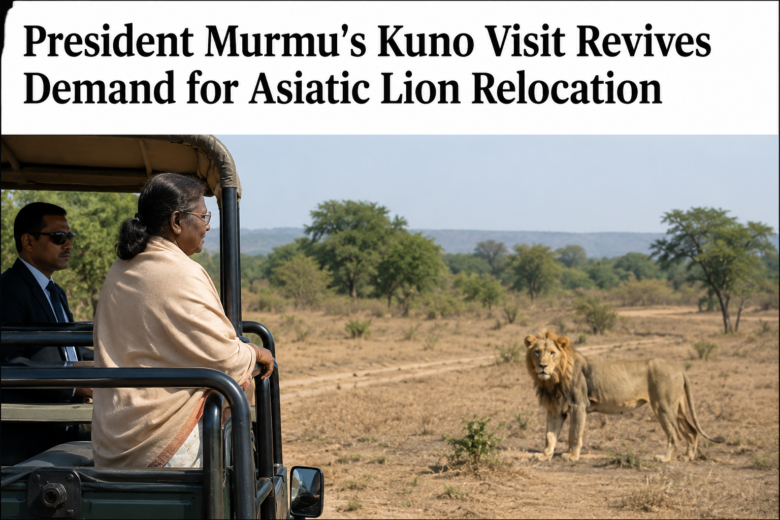
The demand to relocate Asiatic lions to Kuno National Park gained fresh momentum on Sunday during President Droupadi Murmu’s visit to the protected area in Madhya Pradesh’s Sheopur district. Local residents, under the banner of the Kuno Sangharsh Samiti, renewed their appeal to the Central Government to fulfill Kuno’s long-standing role as a second habitat for Asiatic lions.
A group of protesters gathered at Gandhi Park in Sheopur, where they organized a peaceful demonstration and submitted a memorandum addressed to the President through district officials. Led by convenor Atul Chauhan, former district president of the Congress party, participants carried banners and raised slogans supporting lion translocation from Gujarat’s Gir landscape.
According to the committee, Kuno was selected in the early 1990s by the Wildlife Institute of India as the most suitable location for establishing a backup population of Asiatic lions. To support this objective, 25 villages were relocated from the Kuno region, affecting nearly 4,545 families and creating a large, undisturbed wildlife habitat.
The memorandum highlighted concerns over the concentration of the entire wild Asiatic lion population in Gir National Park. It argued that threats such as disease outbreaks, accidents, and natural disasters make the creation of a second secure population increasingly important. The committee also referred to the Supreme Court’s 2013 order that endorsed the relocation of lions to Kuno and described the species as part of India’s national heritage.
Protesters emphasized that the ongoing cheetah reintroduction programme should not be viewed as an obstacle to lion translocation. They maintained that both conservation projects can be managed scientifically within the broader Kuno landscape.
“Kuno was developed specifically to host Asiatic lions, and thousands of local families made sacrifices for this vision. We request the President to encourage the government to move forward with the project,” Chauhan said.
The committee further noted that the arrival of lions could strengthen tourism in the region and generate employment opportunities for local communities.
With the issue once again drawing public attention during the President’s visit, the focus now shifts to whether wildlife authorities and the Centre will reconsider the long-delayed plan to establish a second home for Asiatic lions at Kuno National Park.